It is still raining. Today is August 26, 2026, which puts Broward in late wet season, with hurricane season still active. That is exactly when people ignore the sprinklers. Then November arrives, the afternoon storms quit, sandy soil dries in a few days, and the St. Augustine goes off-color in a week.
EPR Landscaping is licensed, insured, and veteran-owned, based in Pompano Beach. We are the same company as EPR Fencing & Pergolas. Our irrigation techs install, repair, and tune systems so they actually cover the lawn when the dry stretch starts, not just run on a calendar left over from June. The service page is irrigation.
This is the late-summer version of that talk for lots in Pompano Beach, Hollywood, and Davie.
Why a tune-up now, while it is still wet
A tune-up in late August is not about watering more today. It is about catching what summer growth hid, and making sure the system will work when the rain stops.
Summer does this to a Broward system:
- Heads get buried. St. Augustine and weeds grow over spray heads. A buried head waters the thatch, not the turf. You do not see it while afternoon storms are doing the job.
- Heads get knocked. Mowers, edgers, kids, and delivery vans clip risers. A tilted rotor throws a line of water across the driveway and leaves a dry wedge behind the palm.
- Zones drift. A valve that stuck open in July made a swamp by the sidewalk. A valve that barely opens left a brown corner you blamed on fungus.
- Rain sensors get tired. The device that is supposed to hold the system off during a squall is disconnected, clogged, or sitting in a shrub that never dries. The system waters in the rain, which wastes water and keeps the root zone soggy.
- Clocks are still on a May program. That is fine while the sky is doing the work. It is not fine in November.
We would rather find a broken head and a dead sensor in August than find them the first dry week in fall, when every lawn in the county wants a tech on the same Tuesday.
Sandy soil in Pompano Beach, Hollywood, and Davie
Broward is not one soil. A lot of what we stand on is sand, fill, or a thin layer of organics over sand. Water goes through it. That is the whole irrigation problem.
Pompano Beach lots, especially east toward the Intracoastal and in older fill neighborhoods, drain fast. A long cycle that would soak a clay yard here just pushes water past the root zone and into the street. Short, well-aimed cycles on turf beat one long soak that runs off the drive.
Hollywood splits. East of US-1 you are in salt air and sand, with a high water table in places. Inland Hollywood still drinks through sandy profiles under St. Augustine. Coastal beds want different heads and often drip, not a rotor blasting the seagrape.
Davie has more room and more mixed soil, still a lot of sand, plus wider turf, barns, and beds that never see a rotor. Those properties are where we split the work: spray on the lawn, drip on the shrubs and trees, so you are not watering the sky over a hibiscus.
Sandy soil is why a “set it and forget it” clock fails here. The lawn can look fine through wet season on rainfall plus a leftover program, then collapse when the rain stops because the roots are shallow and the heads were never covering the corners.
St. Augustine, which is what most of these yards are, wants deeper, less frequent watering once the system is actually putting water in the root zone. That only works if the heads are upright, matched, and not drowning one bay while skipping the next.
We do not publish a one-size runtime. Sun, shade, zone layout, and how much organic matter is in that sand change it. The tune-up is where we see it.
Rain sensors are not a gadget
Florida requires a working rain sensor or soil-moisture sensor on irrigation systems. New installs need one. Older clocks that were never upgraded should have one. A sensor that is unplugged, painted over, or stuffed in the eaves does not count.
What we see on Broward jobs:
- The sensor was bypassed at the controller so the lawn would “get water” during a dry week in April, and nobody switched it back.
- The sensor is mounted under an eave or a dense hedge, so it never wets, and the system runs through every storm.
- The sensor is mounted, wired, and dead. The clock does not know.
A working sensor holds the system off during and after rain. That is the point in August and September, when we still get bands. It is also how you stop paying to water a wet lawn and then wondering why the turf is yellow from sitting in it.
If you already have a sensor, we test it. If you do not, we install one. That is a normal part of a tune-up, not an upsell speech.
Smart controllers, when they earn their keep
A dumb clock runs the program you typed in, rain or shine, until someone remembers to change it. A smart controller uses local weather or on-site sensors and skips or shortens a cycle when the lawn does not need it.
In Broward that matters at the season change. Wet season and dry season are not a mild shift. One month you are dodging lightning. A few weeks later you are looking at a crunchy parkway strip. A controller that can take a rain skip in September and still water in November is doing the job a sticky note on the garage wall does not.
We install and set smart controllers. We also fix the boring problems first. A Wi-Fi clock on a system with three buried heads and a stuck valve is still a bad system. Coverage, then schedule, then the brain.
We are not putting savings percentages here. Water bills depend on meter size, rates, and how wrong the old program was. What we will say on site is whether your zones make sense, whether turf and beds are on the same valve (they should not be), and whether a controller upgrade is worth it on this property.
What we actually do on a tune-up
We walk the property with the clock, not just open the box and leave.
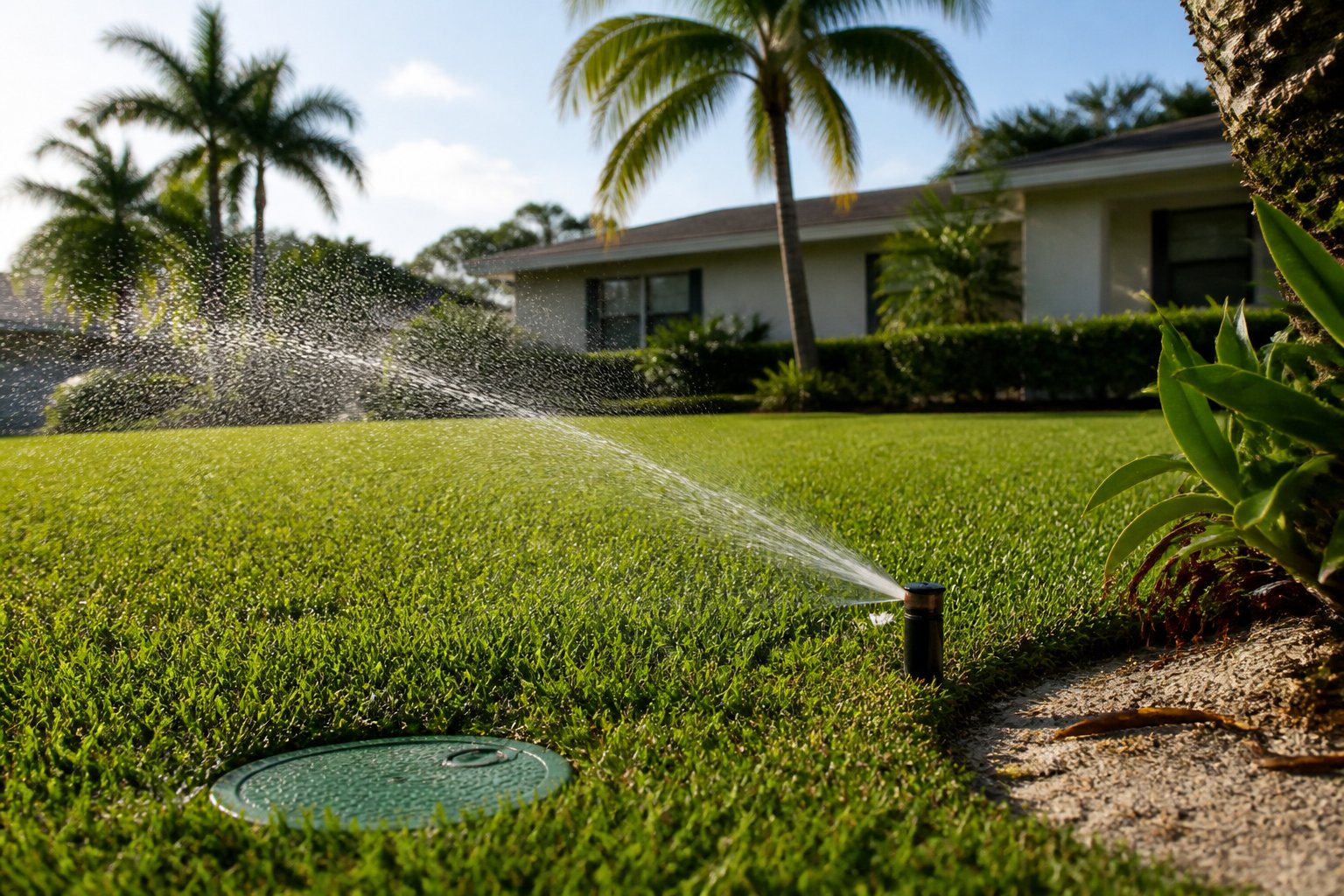
- Turn each zone. Watch the pattern, not the app.
- Lift and reset buried or tilted heads. Replace broken nozzles and cracked risers.
- Check for misting and fogging, usually a pressure problem, not “the grass is thirsty.”
- Look for wet spots that stay wet: leaks, stuck valves, or a low head in a swale.
- Confirm the rain sensor interrupts the system. If it does not, we fix the sensor or the wiring.
- Separate, where we can, turf spray from bed drip. Drip belongs on shrubs, trees, and planting beds. Rotors belong on open St. Augustine.
- Set a program that matches late wet season and can be stepped up when the dry stretch starts. If you have a smart controller, we connect it to weather and stop the old 6 a.m. every-day habit.
Drip that has been baking in mulch all summer clogs. We flush and flag emitters that are done. A bed that is on a spray zone will keep staining the fence and missing the root ball.
Leak detection on a main line is a repair, not a 40-minute tune-up. If we find a zone that will not close or a pipe that is feeding the swale, we tell you before we start cutting. Guessing from the street is how you replace the wrong valve.
You do not always have to be home. For a routine tune-up on a single-family lot where the controller is accessible, we can often run it and leave a note. For a first look, a coverage redesign, or a commercial clock in a locked closet, someone needs to let us in. We sort that when we schedule.
Pompano Beach, Hollywood, Davie, then the rest of the county
We are based in Pompano Beach. Hollywood and Davie are regular irrigation days, not special trips. The product is the same. The soil and the lot size are not, which is why the walk-through matters.
Cities we already serve for this work include Pompano Beach, Hollywood, Davie, Fort Lauderdale, Deerfield Beach, Oakland Park, Lighthouse Point, Hillsboro Beach, Lauderdale-by-the-Sea, Wilton Manors, Coconut Creek, Margate, Tamarac, Lauderdale Lakes, Coral Springs, Parkland, Plantation, Southwest Ranches, and Boca Raton.
HOAs in parts of those cities care about overspray on sidewalks and staining on stucco. A tune-up that aims the heads is also how you stop watering the street. We are not the water district and we are not your association. We will still set the system so it is not the reason you get a letter.
For new installs, repairs, drip, sensors, and controllers, use the irrigation page. For the city we are standing in, use Pompano Beach, Hollywood, or Davie.
The dry stretch will show up whether the clock is ready or not. Late August is when we still have time to aim the heads.
Frequently asked questions
Why tune up the irrigation if it is still raining in August?
Because summer growth buried the heads, and the rain sensor has to work during wet season. The dry stretch, typically when Broward’s afternoon storms fade in fall, is when a neglected system shows. Finding it now is cheaper than finding it when the lawn is already off-color.
Are rain sensors required in Broward?
Florida requires a functioning rain sensor or soil-moisture sensor on irrigation systems. We test the one you have or install one. A bypassed sensor is the same as no sensor.
How does sandy soil change watering in Pompano Beach, Hollywood, or Davie?
Sand does not hold water the way heavier soil does. Long cycles run off or drain past the roots. Coverage has to be even, and turf should not share a valve with drip beds. We set the program to the lot, not to a generic chart.
Do I need a smart controller, or is a tune-up enough?
A tune-up is the first move: heads, leaks, valves, sensor. A smart controller is worth it when the hardware already covers the yard and you want the schedule to follow weather instead of a sticky note. We will say which one you need on site.
Call EPR Landscaping
For an irrigation tune-up in Pompano Beach, Hollywood, Davie, or the rest of Broward before the fall dry stretch, call (954) 461-8466. We will run the zones, test the rain sensor, and tell you if you need a head, a valve, or a controller.
Licensed, insured, veteran-owned. Same company as EPR Fencing. Request an estimate.